


In modern industry, where the pursuit of higher performance and lighter weight is paramount, a material’s specific strength (the ratio of strength to density) and specific modulus of elasticity (the ratio of modulus of elasticity to density, also known as specific stiffness) have become key indicators for assessing its performance.
These parameters directly determine how products perform in sectors such as aerospace, transport and sports equipment. By analysing the performance data of a range of advanced materials, this article clearly illustrates the competition and achievements of different materials in the pursuit of both lightweight design and high strength.
The King of Composite Materials: Carbon Fibre-Reinforced Plastics
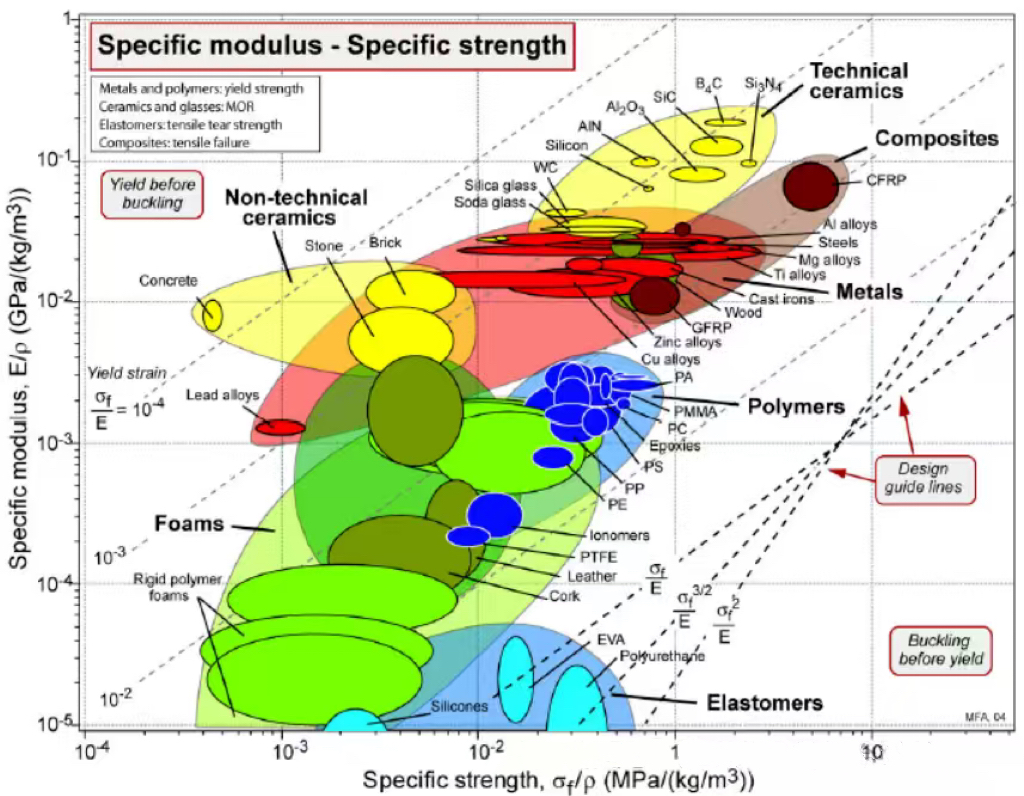
Among the myriad materials available, carbon fibre-reinforced plastics (CFRP) are undoubtedly the shining star. In particular, the T800H/epoxy unidirectional composite boasts astonishing performance figures: a density of just 1.6 g/cm³, yet a tensile strength as high as 2,850 MPa and a modulus of elasticity of 160 GPa. When these figures are converted into specific performance parameters, the advantages become even more apparent—specific strength reaches 18.0×10⁴ m, whilst specific modulus of elasticity is as high as 10.3×10⁶ m, far surpassing those of traditional metallic materials.
This exceptional performance has made CFRP a favoured choice in the aerospace sector. From the wings and fuselage of the Boeing 787 Dreamliner to SpaceX’s rocket components, the use of CFRP has significantly reduced structural weight, thereby enhancing fuel efficiency and payload capacity. It is worth noting that the performance of CFRP is highly dependent on the fibre orientation; although the properties of its quasi-isotropic form are somewhat reduced (specific strength of 5.0 × 10⁴ m and specific modulus of elasticity of 3.8 × 10⁶ m), they still outperform many metallic materials.
The Best Value for Saving Money: Glass-Fibre-Reinforced Plastics
Glass-fibre-reinforced plastic (GFRP), another key member of the composite materials family, offers an excellent balance between cost and performance. Unidirectional E-glass fibre/epoxy resin composites have a density of 2.2 g/cm³, a tensile strength of 1,000 MPa and a modulus of elasticity of 40 GPa, corresponding to a specific strength of 4.5 × 10⁴ m and a specific modulus of elasticity of 1.9 × 10⁶ m.
Although GFRP does not match the performance of CFRP, its cost advantage has led to its widespread use in automotive components, wind turbine blades and shipbuilding. In particular, for high-volume applications where extreme performance is not required, GFRP provides a satisfactory lightweight solution.
Preserving and Advancing Traditional Metallic Materials
Against the backdrop of the rapid rise of composite materials, traditional metallic materials continue to maintain their advantages in specific fields through continuous optimisation.
Aluminium alloys, with their light weight and excellent machinability, continue to hold a prominent position in the aerospace and automotive industries. The 7075-T73 aluminium alloy has a density of 2.8 g/cm³, a specific strength of 2.0 × 10⁴ m and a specific modulus of elasticity of 2.5 × 10⁶ m. Although these figures fall short of those of high-end composite materials, the alloy’s mature production processes and relatively low cost ensure its competitiveness in applications with moderate performance requirements.
Titanium alloys, meanwhile, demonstrate high performance among metallic materials. The Ti-6Al-6V-2Sn alloy has a density of 4.4 g/cm³, a tensile strength of 1,300 MPa, a modulus of elasticity of 120 GPa, a specific strength of 3.0 × 10⁴ m and a specific modulus of elasticity of 2.7 × 10⁶ m. Titanium alloys are significantly superior to aluminium and steel in terms of specific strength, whilst also performing exceptionally well in high-temperature and corrosive environments, making them an ideal choice for aeroengines and chemical processing equipment.
High-strength steel, as the most traditional structural material, remains irreplaceable. Although 9Ni-4Co-0.30C steel has a high density of 7.8 g/cm³, its tensile strength of 1,600 MPa and modulus of elasticity of 200 GPa make it the most economical and reliable choice for applications requiring extremely high levels of absolute strength and stiffness, such as bridge construction and heavy machinery.
Multidimensional Considerations in Material Selection
In practical engineering, material selection involves far more than simply comparing specific strength and specific modulus of elasticity. Cost, workability, corrosion resistance, fatigue resistance, environmental adaptability and recyclability are all factors that must be taken into account.
The anisotropy of composite materials presents both advantages and challenges—whilst offering outstanding performance in the primary load-bearing direction, careful consideration of load orientation is required during the design phase. The isotropy and predictability of metallic materials mean they remain the preferred choice in many traditional structures.
With advances in manufacturing technology, the boundaries of material performance are constantly being pushed. The cost of carbon fibre is gradually falling, enabling its use in a wider range of civilian applications; metal matrix composites, which combine the toughness of metals with the high strength of ceramics, show enormous potential; whilst self-healing and smart responsive materials offer entirely new possibilities for future structural design.
In an era where sustainability is of increasing importance, the life-cycle assessment of materials has also become crucial. The energy efficiency gains achieved through weight reduction must be weighed against the energy consumption and emissions associated with the production of these materials. The future development of materials will inevitably involve striking the optimal balance between performance, cost and environmental friendliness.
Advances in materials science continue to push the boundaries of human industry. From the skies to the oceans, from competitive sport to everyday life, these lightweight yet resilient materials are quietly transforming our world. Understanding their properties and making the most of their advantages will help us create more efficient and sustainable solutions to the challenges of the future.